 venuefinder.nz
Reducing Waste at Corporate Events: Practical Ways for Reducing Waste
Planning a memorable corporate event involves countless decisions, and the goal of reducing waste can often feel like just another expensive item on the to-do list. But here's the thing: creating a greener conference doesn't have to inflate your budget. With some smart, upfront planning, you can make a significant environmental impact without spending an extra dollar.
Greener Events Without a Bigger Budget? It's More Than Possible.
It's one of the biggest myths in our industry: hosting a sustainable corporate event or conference means spending more. The reality is, reducing waste often leads to direct cost savings.
Think about it this way: every printed programme you don't produce, every single-use water bottle you don't buy, and every plate of uneaten food you avoid is money that stays right in your pocket. The key is to shift your focus from pricey, high-tech eco-gadgets to thoughtful, preventative planning.
This whole approach is built on the classic waste hierarchy: Refuse, Reduce, Reuse, Repurpose, and Recycle. By weaving these ideas into your planning from day one, you can systematically design waste right out of the equation before it even becomes a problem.
The Smart Way to Think About Waste Reduction
Going green with your event isn't just about ticking an environmental box; it's a powerful statement about your company's values. Attendees are more conscious than ever of the footprint left behind by the events they go to. A well-run, low-waste event can seriously boost your brand's reputation and show you're in tune with what matters to your audience - all without demanding a bigger budget.
So, how does this actually look in practice? Here are a few cost-neutral actions you can take:
- Refuse: Just say no from the start. Skip the cheap promotional pens and flimsy goodie bags that are destined for the bin.
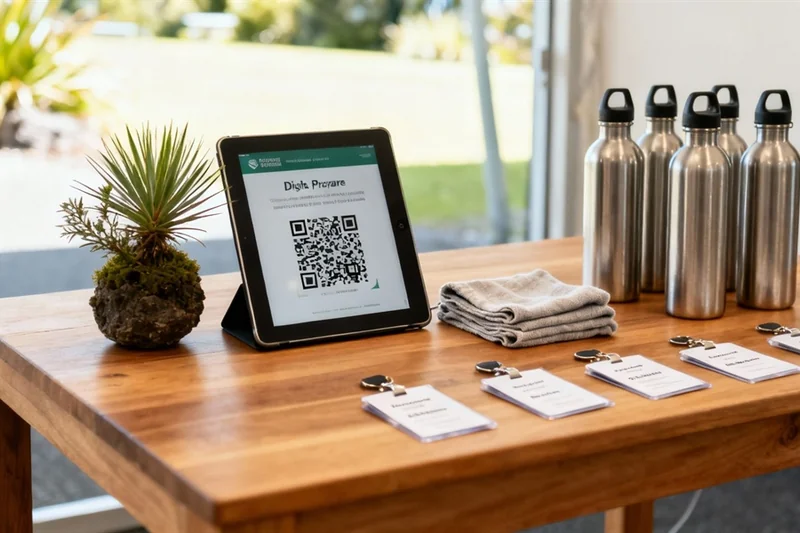
- Reduce: Cut down on physical materials wherever you can. Go digital with your invitations, programs, and feedback forms.
- Reuse: Champion items that can be used over and over again. Think proper crockery and cutlery, linen napkins, and reusable name badge holders.
By making more conscious choices early on, you can significantly reduce your event's environmental impact. This approach is about integrating smart, sustainable thinking into the workflow you already have, not adding complexity to your planning.
This guide will walk you through the process, showing you how simple decisions - from choosing your suppliers to managing things on the day - can lead to a successful, impressive, and eco-friendly event. Getting these details right is a core part of nailing your event finances, and you can learn more in our practical guide to your corporate event budget. We're here to prove that sustainability and event success really do go hand-in-hand.
Laying the Groundwork in Your Pre-Event Planning
The biggest wins in slashing waste at your corporate event happen long before the first guest walks through the door. By weaving sustainability into your planning from day one, you set a clear direction that makes every decision afterwards easier and far more impactful. This is where you draw up the blueprint for a low-waste event.
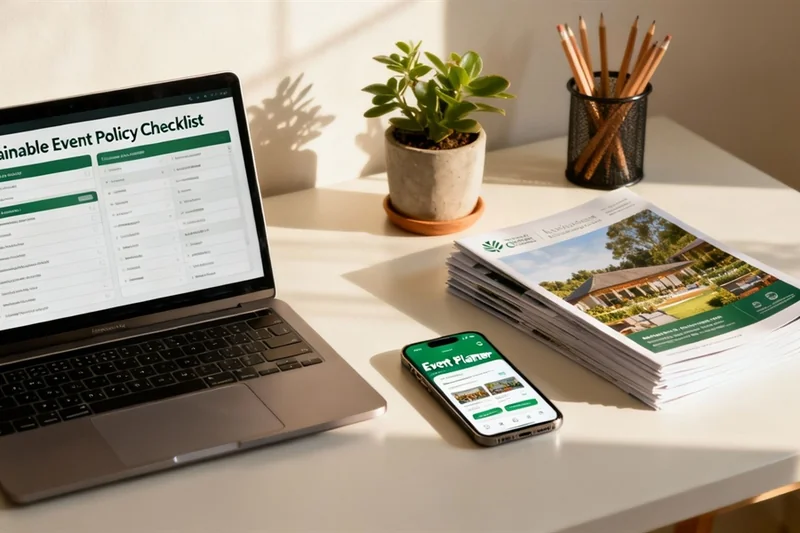
It all starts with a simple 'Sustainable Event Policy'. Don't let the name intimidate you; this doesn't need to be some dense, complicated document. Think of it as a one-page guide that clearly outlines your green goals. It becomes your north star for everything from picking a venue to signing vendor contracts.
Armed with this policy, you can have much clearer conversations with suppliers. Instead of making vague requests, you can ask specific questions that really test their commitment to green practices. It gets everyone on the same page, focused on your mission to reduce waste without blowing the budget.
Embrace Digital-First Strategies
One of the easiest - and most budget-friendly - ways to cut down on physical waste is to go digital right from the get-go. This shift doesn't just save trees; it also wipes out significant printing and distribution costs, proving that sustainability can be a smart financial move.
Think about swapping out the old-school stuff for these digital alternatives:
- Event Apps Over Paper Programmes: A dedicated event app can hold the agenda, speaker bios, and venue maps, making printed programmes totally unnecessary.
- QR Codes for Engagement: Use QR codes for checking in attendees, gathering session feedback, and capturing leads. No more paper forms.
- Digital Invitations and Tickets: Send all your invites, confirmations, and tickets via email to ditch paper and postage for good.
This approach not only shrinks your event's physical footprint but also delivers a more modern, interactive experience for your attendees. It's a classic win-win. By prioritising digital communication, you proactively design waste out of your event plan. The savings on printing alone can often be redirected to other areas of your budget, proving that green choices can be economically smart.
Choose a Venue with Sustainability Built-In
Your choice of venue is probably the single biggest decision you'll make on your waste reduction journey. When you partner with a location that already has solid sustainability programmes in place, you get a massive head start. These venues typically have well-oiled systems for waste sorting, composting, and energy conservation.
When you start your search, keep an eye out for venues that are already leading the way. Look for features like:
- Comprehensive on-site recycling and composting facilities.
- Partnerships with local food rescue organisations.
- Default use of reusable crockery and glassware.
Picking a venue that shares your values makes your job infinitely easier. They become an active partner in your mission, providing the infrastructure and know-how needed to pull off a successful, low-waste corporate event. Discover suitable venues with us at Venue Finder NZ.
Choosing Partners Who Share Your Green Vision
Your suppliers and vendors aren't just service providers; they're your most important allies in the mission for a low-waste corporate event. It's one thing to have a green vision, but it's another to bring it to life, and you can't do it alone.
Partnering with people who already get it - who prioritise sustainability in their own operations - is the secret sauce. This isn't just helpful, it's essential if you want to hit your goals without blowing the budget. The right team won't just follow instructions; they'll actively bring ideas to the table, making your job a whole lot easier.

The key is to ask sharp, insightful questions before you sign any contracts. Forget a simple "Are you sustainable?" You need to dig into the nitty-gritty of how they work to make sure their practices actually match their promises.
Vetting Your Catering and Décor Partners
When you're talking to potential partners, focus on their day-to-day habits. A genuine commitment to reducing waste isn't an expensive add-on; it's woven into their standard workflow.
Here are a few questions I always ask when vetting caterers, decorators, and equipment hire companies.
Key Questions for Potential Suppliers:
- Packaging: "How do you deliver your food and gear? Are we talking reusable crates and containers, or is it all single-use plastic wrap and cardboard?"
- Sourcing: "Can you source ingredients locally to cut down on food miles? What relationships do you have with local growers?"
- Waste Management: "What's your standard process for sorting waste back at your facility? Do you separate compostables, recycling, and landfill?"
- Surplus Food: "What's your policy for leftover, unserved food? Do you work with any local food rescue organisations?"
Their answers will tell you everything you need to know. A truly green partner will have clear, confident responses and might even throw in a few waste-saving ideas you hadn't thought of. For a deeper dive, check out our guide on how to choose the right corporate caterer for your event.
Practical Strategies for Food and Décor
Once you've picked your team, the real collaboration begins. With catering, zero in on tangible swaps that get rid of disposables. Asking for bulk condiment dispensers instead of those tiny single-serve sachets is a simple but effective change.
And please, insist on real crockery, glassware, and cutlery. So many caterers offer this as standard, and it instantly elevates the guest experience while cutting out a massive source of landfill waste.
On the food waste front, while national trends are improving, there's always more we can do at our events. The 2025 Rabobank-KiwiHarvest Food Waste survey found the average New Zealand household wastes 10.9% of food bought weekly, costing them $1,364 a year. By managing your conference catering carefully, you're contributing to a much bigger solution. You can explore more insights into New Zealand's food waste challenges to see the scale of the issue.
The same thinking applies to décor. Instead of buying decorations that will be used once and then binned, make renting your default. Everything from table centrepieces to statement lighting can be hired.
An even greener idea? Partner with a local nursery to use living plants as decorations. They look fantastic, and they can be returned and enjoyed long after your conference has wrapped up. It's a beautiful way to support another local business and ensure absolutely nothing goes to waste.
On-Site Management for a Low-Waste Corporate Event
All your meticulous planning comes down to this: execution on the day. This is where your waste reduction strategy moves from paper to practice, and it's your on-site management that will make or break it. The real goal is to make sustainable choices the easiest, most intuitive option for everyone, from your attendees to your event crew.
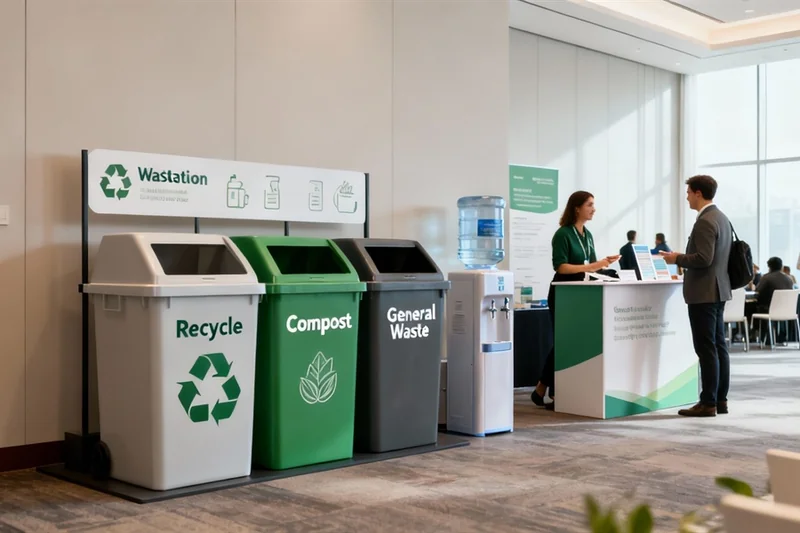
Success really hinges on making the right thing the easy thing to do. One of the most visible - and impactful - parts of this is your waste stations. We've all seen it: a lonely recycling bin next to a confusing general waste bin, leading to contamination. Well-intentioned guests end up accidentally throwing perfectly recyclable items into the landfill pile.
Designing Intuitive Waste Stations
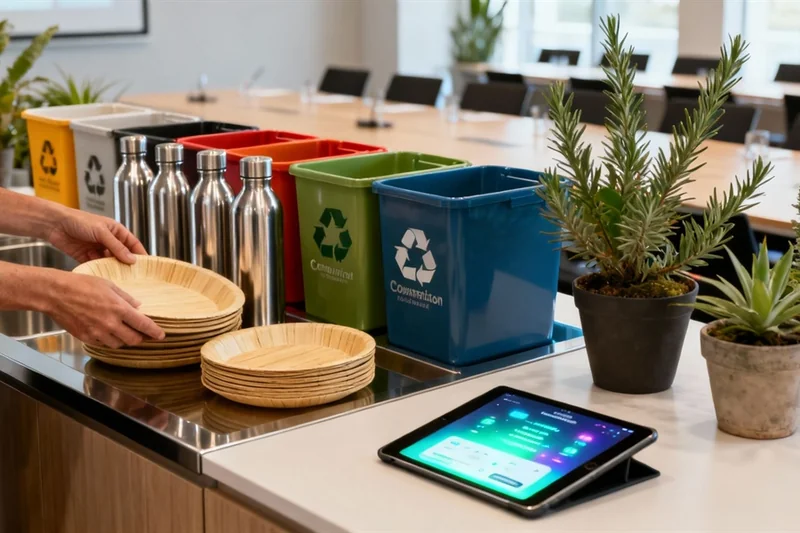
Let's fix that. The key is to design clear, intuitive waste stations. Always cluster your recycling, compost, and general waste bins together in high-traffic areas - never let one stand alone.
But the real game-changer is visual signage. Ditch the wordy labels and use large, simple images of what goes in each bin. A picture of a coffee cup, a food scrap, a plastic bottle. This simple approach cuts through any confusion, removes language barriers, and helps people sort their waste correctly in seconds. A well-designed station can dramatically lift your diversion rate without costing an extra cent.
Of course, your team on the ground are your ambassadors. Pull your event staff aside for a quick pre-event briefing. You don't need to turn them into waste experts, but they should understand the sorting system and feel confident gently guiding guests. A little knowledge empowers them to lead by example.
Don't forget to bring your attendees on the journey with you. A brief, positive announcement from the MC at the start of the conference can set a collaborative tone. A simple line like, "We're aiming for a low-waste event today, so please use the clearly marked recycling stations," makes everyone feel part of the effort.
Managing Leftovers and Reusables
No matter how perfectly you plan, there will probably be leftovers. This is where a pre-arranged partnership with a local food rescue organisation becomes invaluable. It's a powerful way to ensure good, untouched food nourishes people, not landfills, turning a potential waste stream into a genuine community benefit.
As the day wraps up, there's another easy win. Instead of letting attendees take home name badges and lanyards that will probably end up in the bin, set up a collection point near the exit. These are items you can easily reuse for future events, saving money and resources. You can often find these alongside other essentials, and our guide to sourcing event equipment hire can point you in the right direction.
And finally, one of the simplest yet most effective tactics? Ditch single-use plastic water bottles. Provide clearly marked water refill stations and encourage attendees to use their own bottles or the reusable cups you've provided. It's a highly visible commitment that normalises a culture of reuse from the moment guests arrive.
Looking for some straightforward ideas you can implement on the day? Here are a few high-impact actions that cost nothing but can make a big difference.
Quick Wins for Reducing Waste On-Site
| Action Item | Waste Reduced | Cost Impact |
|---|---|---|
| Set screen savers to display key info | Paper from printed agendas & signs | Zero Cost |
| Announce waste goals from the stage | Contamination in recycling/compost bins | Zero Cost |
| Create a collection point for name badges | Plastic & lanyard waste | Zero Cost |
| Promote water refill stations | Single-use plastic bottles | Zero Cost |
| Brief staff on correct bin usage | Contamination from incorrect sorting | Zero Cost |
| Work with caterers on portion control | Food waste from surplus servings | Potential Savings |
These small adjustments are easy to integrate into your run sheet but collectively steer your event towards a much greener outcome. It's all about making smart, simple choices on the day.
Post-Event: Measuring Success and Planning Ahead
Right, the event's wrapped up, the last guest has gone home, and you can finally put your feet up. But the work isn't quite over yet. If you really want to make a lasting impact, what you do after the event is just as important as what you did before.
This is where you measure your wins, learn from the process, and set yourself up to do even better next time. It's how you turn a one-off success into a long-term, sustainable practice that becomes second nature.
Seeing How You Did
Getting a handle on your success doesn't have to be complicated. You can start with some simple, powerful metrics that give you a clear picture of what you achieved.
A great first step is to ask your venue for a post-event waste report. This will break down how much went into recycling and compost versus what ended up in the general landfill bin. This data is gold - it gives you a tangible benchmark to improve on for your next conference.
Turning Numbers into Action
Once you've got the data, it's time for a debrief. Get your team and key suppliers in a room (or on a call) and have an honest chat about what worked and what didn't.
Were the signs on the waste stations clear enough to keep recycling streams clean? Did the partnership with the food rescue organisation run smoothly? Maybe you found out attendees were confused about which bin a specific compostable cup went into, or that you could have collected even more reusable name badges with a clearer drop-off point.
Celebrating your wins is crucial, but so is spotting where you can grow. Every event is a chance to learn and fine-tune your approach, making sustainability an easier, more integrated part of your planning process each time.
This cycle of improvement is more important than you might think. The waste sector makes up about 4% of New Zealand's total greenhouse gas emissions, and the government has made it a national priority to reduce what we send to landfill. Your efforts are a direct contribution to a much bigger solution. Discover more about New Zealand's waste challenges.
Share Your Sustainable Story
Finally, don't keep your good work a secret. Let your stakeholders, sponsors, and attendees know what you accomplished.
A quick post-event email or a social media update with a few key stats - like the kilograms of food donated or the number of single-use plastic bottles avoided - is a powerful way to show your brand's commitment to doing things better.
By turning your event into a positive case study, you're not just celebrating a great conference. You're setting a new standard for others in the industry and cementing your reputation as a forward-thinking leader. It's proof that with a bit of thoughtful planning, reducing waste isn't just possible - it's just good business.
Got Questions About Cutting Down Event Waste?
When you first start diving into sustainable event planning, it's natural for a few questions to pop up. It's a common topic of conversation with organisers we work with, so here are some straightforward answers to the queries we hear most often.
Can I Really Pull Off a Low-Waste Event Without Blowing the Budget?
Absolutely. In fact, many of the smartest waste-reduction strategies are actually cost-savers. Think about it: switching to digital invites and programmes completely cuts out printing and postage fees. Opting for water refill stations instead of buying pallets of single-use plastic bottles is almost always cheaper for your event, too.
The real secret is planning ahead. When you're choosing your suppliers and venue, make it a priority to find partners who already have sustainable practices baked into their standard operations. Green choices shouldn't come with a premium price tag; they're just a sign of a well-run, efficient business.
How Do I Get Attendees on Board with Our Green Goals?
Good, clear communication is your best friend here. A quick mention of your green initiatives in pre-event emails or on your event app gives everyone a heads-up. Once you're on-site, a short, positive announcement from the MC can work wonders to bring everyone along for the ride.
But most importantly, make it ridiculously easy for them to help. Use clear signs with pictures on your waste stations so people know exactly where to put their rubbish without having to think too hard. You'll find most attendees are more than happy to do the right thing when the process is simple and intuitive.
What's the Single Biggest Thing I Can Do to Reduce Food Waste?
Nailing your headcount. It sounds simple, but it's your most powerful tool. Work with your caterer to finalise your attendee numbers as late as you possibly can to avoid ordering way too much food. This one action has the single biggest impact on cutting food waste at any corporate event.
The next best thing? Have a plan for leftovers. Before the event even starts, set up a partnership with a local food rescue organisation. This ensures any untouched, safe-to-eat food goes to people who need it, not to the landfill. It's a simple arrangement that diverts a huge amount of would-be waste.
What if My Preferred Venue Doesn't Have Great Recycling Facilities?
This is a brilliant question to ask right at the start of your venue search. If you're already locked into a venue, ask if you can bring in your own specialised waste management contractor. Another clever workaround is to control what you bring in. For example, you could make sure all your service-ware is made from a single type of compostable material and then arrange for a dedicated collection service to handle just that.
Ready to find a venue that shares your commitment to sustainability? We make it easy to discover spaces across New Zealand with robust green practices already in place. Start your search and plan your next successful, low-waste corporate event with us today. Find the perfect space at https://venuefinder.nz.