 Venue Finder
Wedding Invitations: Your NZ Guide to Wording, Etiquette, and Timelines
29 Dec 2025 by Venue Finder NZ
Your wedding story starts long before you walk down the aisle. It begins with the communication you send to your guests - the first, tangible hint of the celebration to come. Think of it as the opening scene of your big day, setting the tone and atmosphere and making your guests feel like a cherished part of your story from the very beginning.
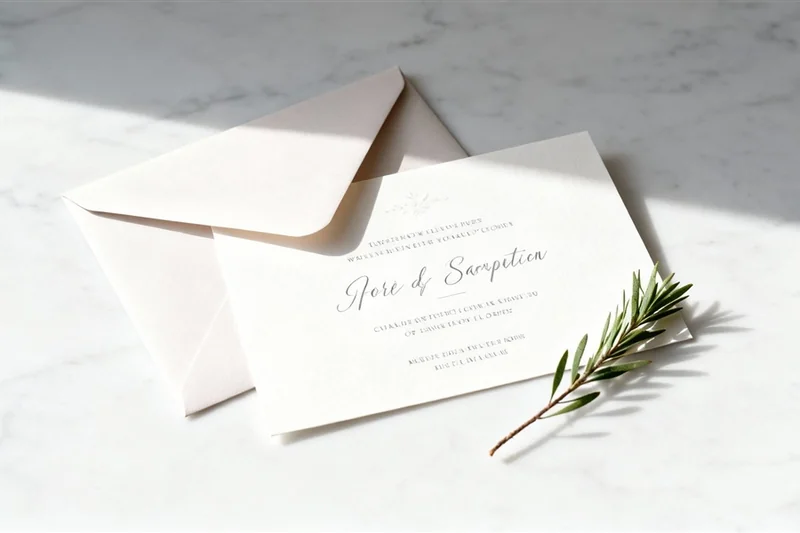
Your Wedding Communication Guide
It is helpful to think of your wedding communication not as a single card, but as a coordinated suite of tools. Each piece, from the first announcement to the final headcount, has a specific job to do, working together to build excitement and keep everyone in the loop.
Getting this sequence right is one of the secrets to a stress-free planning process. It stops any last-minute panics and makes sure you have all the essential information you need from your guests, right when you need it.
The First Hint: Save the Dates
Save the Dates are the exciting curtain-raiser for your formal invitations. You will want to send these out 6 to 12 months in advance, especially if you are planning a destination wedding or have lots of guests travelling from afar. Their job is beautifully simple: announce your names, the wedding date, and the city or town where it is all happening.
This heads-up gives your loved ones plenty of time to book flights, sort out accommodation, and get their leave approved. It is a thoughtful little gesture that goes a long way in making sure the people you care about most can be there to celebrate with you.
The Main Event: The Formal Invitation
This is the centrepiece of your wedding stationery. Sent out around 8 to 12 weeks before the big day, the formal invitation is where you lay out all the essential details. It is the official request for your guests' presence, covering the who, what, where, and when of your ceremony and reception.
But it is so much more than just logistics. The invitation is a powerful tone-setter. The feel of the paper, the style of the font - every detail gives your guests a real sense of what to expect, whether it is a relaxed garden party or a grand black-tie affair.
Creating a Central Hub with a Wedding Website (Optional)
While it is optional, a wedding website is an incredibly useful tool for modern couples. It acts as a central hub where guests can find answers to all their questions, which means fewer panicked texts and calls for you! It is the perfect place to put all the extra details that will not fit on the invitation, such as:
- Detailed Directions: Maps and clear instructions for getting to your ceremony and reception venues.
- Accommodation Suggestions: A helpful list of nearby hotels or transport options.
- Your Story: A chance to add a personal touch, sharing how you met or introducing your wedding party.
- Gift Registry: A discreet and easy place to link to your gift registry, if you have one.
Closing the Loop: RSVP Tracking
Getting a final headcount is absolutely vital for locking in your plans with suppliers. Your invitation will include a reply card or direct guests to your website to RSVP by a specific date, usually about 4 weeks before the wedding. Hitting this deadline is crucial. It allows you to give final numbers to your caterer and finalise the seating plan for your venue, making sure your day runs without a hitch.
Crafting the Perfect Message: What to Include
So, you have picked a style for your invitations. The next big step is figuring out exactly what to say inside. Getting the wording right is your secret weapon to making sure guests feel welcome, informed, and genuinely excited for your big day.
Think of your invitation as a friendly guide that answers all their questions before they even have a chance to ask.
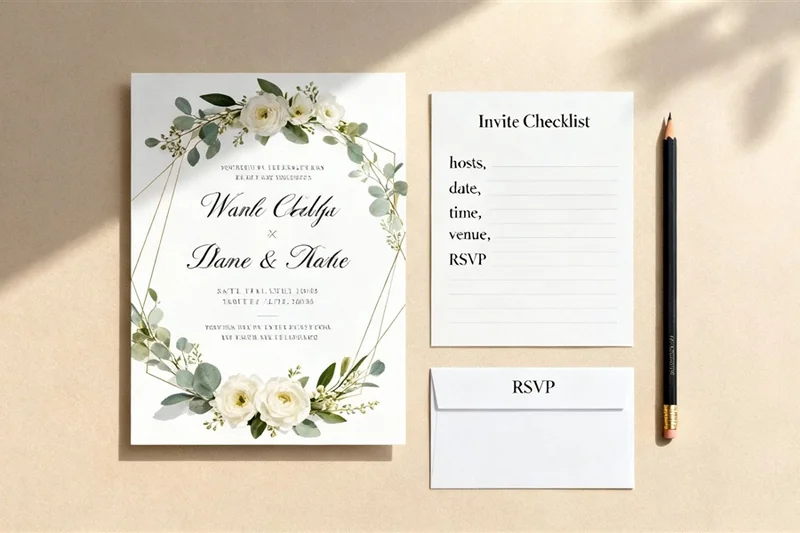
Nailing this part saves you from a flurry of last-minute texts and calls. When everyone knows exactly where to be and when, you can relax and focus on those final, exciting preparations.
The Essential Information Checklist
Every invitation, whether formal or casual, must include several essential elements to prevent guest confusion. Let's outline the key components for your main invitation card:
- Who is Hosting? This is traditionally the first line, indicating who is hosting the wedding - be it the parents of one partner, both sets of parents, or the couple themselves.
- The Invitation Itself: This is the core message. Formal events might use phrases like "request the honour of your presence," while a more relaxed tone such as "would love for you to join them" suits informal gatherings.
- Your Full Names: Clearly state the names of the couple getting married.
- The Date and Time: To avoid confusion, write out the full date, including the day of the week, and specify the time with a.m. or p.m.
- The Venue Addresses: Provide the full, specific street addresses for both the ceremony and reception. If they are at the same location, make that clear. It is important not to assume guests know where a popular venue is, so include the complete street address and suburb to prevent anyone from getting lost on the day.
Thoughtful Extras for a Seamless Guest Experience
Going beyond the basics shows you have really thought about your guests' experience and makes life so much easier for them. These extra details usually live on a separate 'details card' tucked into the invitation suite or are clearly laid out on a wedding website.
Providing a bit of extra guidance helps everyone feel comfortable and prepared, ensuring the day runs smoothly and just as you have envisioned it.
- Dress Code: This is a lifesaver for guests. Specifying "black tie," "cocktail attire," or "garden party casual" takes all the guesswork out of their outfit planning and ensures everyone feels appropriately dressed.
- Gifts: If you have a gift registry, your wedding website is the best place to share the link. Otherwise, a polite line like, "Your presence is our present, but if you wish to give a gift, a wishing well will be available on the day" is a lovely way to guide your guests.
- Transport and Accommodation: This is a huge help for anyone travelling from out of town, or if your venue is a bit off the beaten track. Suggesting local hotels or transport options is a really considerate touch. You could even arrange a shuttle bus from a central location to make things super easy.
By carefully planning the words inside your wedding invitations, you create a warm, welcoming first impression. This clear communication sets the stage for a relaxed, joyful celebration where everyone feels looked after from the moment they open that envelope.
Choosing an Invitation Style That Reflects You
Your wedding invitation is so much more than just a piece of paper; it is the very first glimpse your guests will have of your special day. Think of it as the opening scene, setting the tone for the entire celebration and giving everyone a taste of your unique style as a couple.
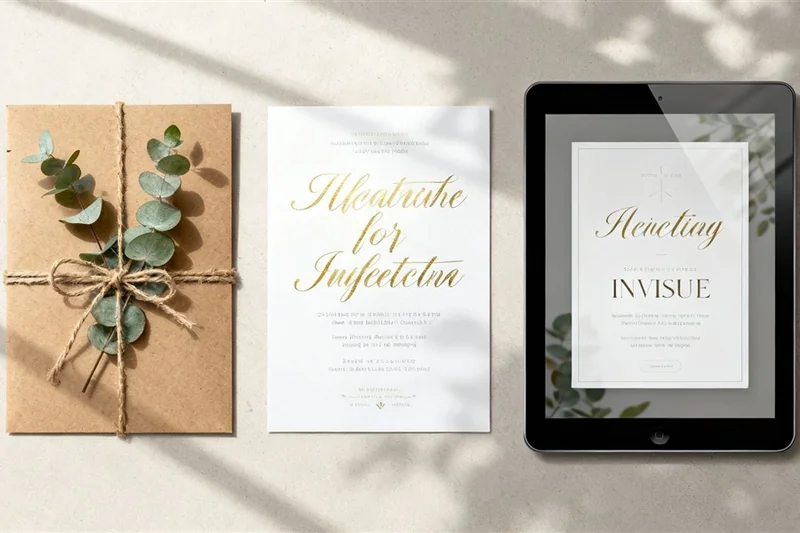
The style you land on can hint at anything from a laid-back, rustic gathering to a formal, black-tie affair. It is essentially the movie trailer for your wedding - it should capture the vibe, build excitement, and let your guests know what to expect. Let us walk through the most popular options here in New Zealand to help you find your perfect match.
Timeless Printed Wedding Invitations
You cannot go wrong with a classic. For many couples, the tradition of a printed invitation is something they truly cherish. There is just something special about receiving a beautifully crafted card in the post; it feels personal, significant, and a world away from a cluttered inbox.
This route gives you endless room for creativity, from the luxurious feel of heavy cardstock to elegant details like embossed lettering or a touch of metallic foil. A printed invitation often becomes a treasured keepsake, not just for you but for your guests too. It is a perfect fit for any wedding, whether you are planning a formal church service or a relaxed beach ceremony. The design can be tailored to echo your theme, tying in the colours and motifs that will feature throughout your wedding, much like you would coordinate your florals. For more ideas on that, check out our complete guide to wedding flowers in NZ.
Modern and Convenient Digital E-Invites
For those seeking a modern, eco-friendly, or budget-conscious option, digital e-invites are an excellent choice. Delivered instantly via email or a dedicated wedding website, they simplify RSVP tracking and allow you to include links to your wedding website, gift registry, and maps, keeping everything organized.
Digital doesn't mean less beautiful; e-invites can be as stunning as printed ones, often featuring animations, personalized music, or interactive elements. They are especially useful for casual weddings or for couples with many guests overseas, avoiding postage costs and mail delays. E-invites are also an effective tool for managing your guest list, allowing you to easily monitor who has opened the invitation, who has responded, and any dietary requirements, all updated in real-time.
Elegant Bespoke Designs
Got a specific vision that you just cannot find in an off-the-shelf design? Going bespoke is the ultimate way to create something that is uniquely you. Working one-on-one with a professional stationer or graphic designer allows you to bring your dream invitation to life, whether that is a custom illustration of your venue or a monogram that tells your love story.
This collaborative process ensures every single detail, from the typography to the colour palette, is perfectly in tune with your personal style. While it is more of an investment, the result is a one-of-a-kind piece of art that sets the perfect tone for your wedding day.
Considering Your Budget
Let us be real - your budget is going to be a big factor in your decision. Wedding costs in New Zealand can vary hugely, and stationery is one area where couples often make creative and practical choices. To put it in perspective, read insights from a survey by Capsule NZ which notes that the average total wedding budget is under $25,000.
Digital invitations can slash your stationery costs to almost zero, which is a massive win for a tight budget. On the other hand, traditional printed options typically average between $4 and $7 per guest. It is all about finding what feels right for you and your finances.
Mastering Invitation Wording and Etiquette
Figuring out the right words for your wedding invitations can feel like a high-stakes puzzle. You are trying to be clear, warm, and respectful, all while capturing the unique vibe of your celebration. This is where a little bit of etiquette know-how becomes your best friend, guiding you to craft a message that sounds like you and makes every guest feel genuinely welcome.
The tone you set here is a big deal. It is the first impression your guests will have of your wedding day, distinguishing between a grand, formal affair and a relaxed party with your favourite people. Let us walk through the nuances to help you hit just the right note.
Setting the Tone: Formal vs. Casual
First things first: decide how formal you want your wedding to be. This choice will ripple through every word you write, from the opening line to how you list the date and time. Take a cue from your venue's atmosphere - are you in a sophisticated city space, or a laid-back spot? Let your venue's personality inspire your language.
A formal invitation typically uses traditional phrasing, like "request the honour of your presence," and spells out all the numbers and times. On the flip side, a casual invitation might use more conversational language, something like, "invite you to celebrate their wedding." There is no right or wrong here; it is all about what feels authentic for you as a couple.
To help you see the difference in action, here is a quick comparison.
Wedding Invitation Wording: Formal vs. Casual
The formula:
Host Line
Request to Attend
Date
Time
Reception Info
Formal wording example:
Mr and Mrs John Smith
request the honour of your presence
at the marriage of their daughter
on Saturday, the fifth of October, two thousand and twenty five
at half-past two in the afternoon.
Dinner and dancing to follow.
Casual wording example:
Together with their families, [Partner 1] and [Partner 2]
invite you to celebrate
as they tie the knot
on Saturday, 5th October 2025
at 2:30 in the afternoon.
Reception to follow.
Ultimately, the goal is to create an invitation that feels like a natural extension of the celebration you are planning.
Navigating Modern Family Dynamics
Families today are beautifully diverse, and your wedding invitations should absolutely reflect that. The old-school rules do not always fit, so it is important to find wording that feels respectful and inclusive for your unique situation.
- When the Couple is Hosting: If you are footing the bill yourselves, the invitation should come straight from you. A simple and elegant way to phrase it is, "Together with their parents, [Partner 1 Name] and [Partner 2 Name] invite you to celebrate their marriage."
- Invitations from Divorced Parents: When divorced parents are co-hosting, list each parent on a separate line. Traditionally, the mother's name comes first. For example: "Mrs Jane Smith and Mr John Smith request the pleasure of your company..."
- Honouring a Deceased Parent: To acknowledge a parent who has passed away, you can include them with a touching line like, "Jane Smith, daughter of Mr John Smith and the late Mrs Mary Smith..." It is a lovely way to ensure they are part of the celebration in spirit.
Incorporating New Zealand's Heritage
Weaving te reo Māori into your wedding invitations is a wonderful way to honour New Zealand's bicultural heritage. It can add a layer of deep meaning and cultural richness that makes your stationery truly special.
You could include a whakataukī (proverb) that speaks to love and unity, or simply use te reo for key phrases. This focus on meaningful language goes hand-in-hand with the care you take when choosing a wedding celebrant, ensuring every part of your day feels personal and significant.
Politely Clarifying Important Details
It is important to be direct, courteous, and clear when communicating specific details that might be uncomfortable, such as hosting an 'adults-only' reception. Being clear is considerate, so it is advisable to express your intentions plainly on a details card or website to prevent misunderstandings. For example, you might softly state that you request an adults-only celebration.
Additionally, for gift preferences, you can kindly guide your guests by noting that their presence is the greatest gift, but if they wish to give something, a wishing well will be available. Including these details on an insert card or wedding website helps keep the main invitation elegant and focused on the celebration. For more guidance, you can visit our blog on Your Complete Guide to Managing Wedding Guests in NZ.
Your Essential Wedding Invitation Timeline
Good timing is the secret to keeping your wedding planning stress-free, and your invitations are no exception. Getting your communication timeline right means your guests have all the information they need, RSVPs roll in on schedule, and you can lock in final details with your suppliers without any last-minute panic.
Think of it as a series of carefully planned steps, one building on the next. From giving your loved ones an early heads-up to chasing that final reply, a clear timeline keeps everything organised and under control. Let us walk through every key milestone for your wedding invitations.
The First Announcement: Save the Dates
Save the Dates are your wedding's opening act. They are a simple, exciting heads-up for your guests, letting them know your date and location so they can start making plans. This is especially crucial for destination weddings or if you have a lot of guests travelling.
- When to Send: Aim for 6 to 12 months before your wedding day. If you have international guests, the earlier, the better.
- What to Include: Keep it brief and punchy. All you really need are your names, the wedding date, and the city or town. It is also a good idea to mention that a formal invitation will follow.
This early notice is a thoughtful gesture that helps guarantee your favourite people can clear their schedules to celebrate with you.
Ordering and Mailing Your Formal Invitations
This is the main event in your stationery journey. Your formal wedding invitations contain all the important details and officially ask for your guests' attendance. You will need to allow adequate time for design, printing, and postage, as a common pitfall is underestimating production time, especially for custom designs. It's recommended to start discussions with your stationer at least 4 to 5 months before your wedding to avoid any rush.
Once they are ready, it is time to send them out. The ideal timeframe for mailing your invitations is 8 to 12 weeks before the big day, allowing guests ample time to respond without the date feeling too far away. This practice is common in New Zealand, where intimate weddings with an average of 89 guests are popular.
Setting a Strategic RSVP Deadline
Your RSVP deadline is one of the most important dates in your entire wedding planning timeline. This is the date you need guests to confirm by, and that final number is critical for your venue and caterer.
Set your RSVP deadline for 3 to 4 weeks before your wedding. This buffer gives you a crucial window to:
- Politely chase up any late responders (there will always be a few!).
- Finalise your seating plan.
- Confirm meal choices with your caterer.
- Give final headcounts to all your key suppliers.
Having a clear timeline in place is a cornerstone of good organisation. To see how this fits into the bigger picture, check out our essential guide to planning a wedding in NZ. By following this simple schedule, you can make sure every piece of communication is sent at the perfect moment, keeping you and your guests perfectly in sync.
Managing Guest RSVPs Without the Stress
Once your beautiful wedding invitations are out in the world, the next crucial phase begins: managing the replies. This is where your guest list transforms from a hopeful draft into a concrete plan, letting you lock in the final, critical details with your venue and suppliers.
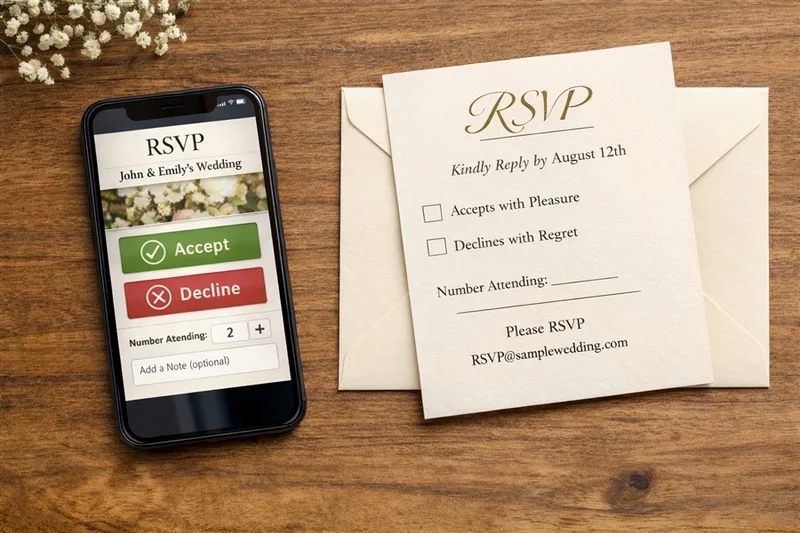
Keeping this process organised is the key to a calm and collected final few weeks of planning. Smooth RSVP tracking makes all the difference, as it gives you an accurate headcount that directly impacts everything from your catering costs to your seating chart.
Choosing Your RSVP Method
How you ask people to reply can make your life a whole lot easier. Modern couples have a few great options, and you can choose whatever best suits your wedding style and how you like to keep things organised.
- Traditional Mail-In Cards: There is a timeless charm to receiving a physical reply card in the post. This classic method is straightforward for guests of all ages and adds a lovely, personal touch.
- Digital RSVP via a Wedding Website: This is an incredibly efficient option. Guests can reply instantly online, and their responses - along with meal choices and dietary needs - are automatically compiled into a neat digital spreadsheet for you.
Many couples we work with find a hybrid approach is the perfect solution. They send a beautiful printed invitation that directs guests to a wedding website to RSVP. This gives you the best of both worlds - the elegance of traditional mail with the convenience of digital organisation.
Handling Responses Gracefully
Managing RSVPs involves more than just counting attendees; it requires clear and courteous communication with your guests, including politely following up with late responders, which is a normal part of the process. A gentle, friendly message a day or two after the deadline usually suffices to obtain the final responses you need.
Additionally, when guests add an uninvited plus-one or inquire about bringing children to an adults-only event, addressing this with a polite and direct private conversation, such as a simple phone call explaining your venue's constraints, is often the kindest and most effective way to prevent any awkwardness.
Your Wedding Website as an Information Hub
A wedding website does so much more than just collect RSVPs. Think of it as a central hub of information that can save you countless hours answering the same questions over and over. By putting all the key details online, you free up your time and energy for the final, exciting preparations.
This is the perfect place to share logistics like maps to the venue, local accommodation suggestions, and the day's timeline. It is also where you can provide useful reminders about transport options or dress code specifics. In New Zealand, the average wedding hosts around 89 guests, which is a lot of people to keep in the loop!
Ultimately, a well-managed RSVP process is the cornerstone of a smooth final month of planning. For more tips on keeping your big day calm and organised, you can also check out our guide on how to plan a stress-free wedding day.
Your Wedding Invitation Questions Answered
Working your way through the finer details of wedding invitations always brings up a few questions. To help you feel confident as you get them sorted, we have put together some quick, clear answers to the queries we hear most often from Kiwi couples.
When Is the Best Time to Send Wedding Invitations in NZ?
For weddings happening here in New Zealand, a good rule of thumb is to send your wedding invitations 8 to 12 weeks before the big day. This gives your guests plenty of notice to make plans and RSVP without it feeling so far away that it slips their minds.
But if you have a lot of friends and family travelling from overseas or you are planning a destination wedding, you will want to give them more time. Aim to post those invitations 3 to 4 months in advance. For these situations, sending a Save the Date notice 6 to 12 months beforehand is an absolute must.
Are Digital Wedding Invitations Acceptable?
Absolutely. Digital invitations are a brilliant choice these days. They are eco-friendly, kind to your budget, and a lifesaver for tracking RSVPs, especially if you need to send out a quick update. They work particularly well for more casual, relaxed weddings.
For a more formal affair, many couples still love the classic, tangible feel of a printed invitation. A perfect middle ground is to send a beautiful physical invitation that directs guests to your wedding website for all the nitty-gritty details and to RSVP online.
Difference Between a Save the Date and an Invitation
A 'Save the Date' serves as a courteous early notice, typically sent 6–12 months before the event. It informs guests of the wedding date and location, allowing them to reserve the date. The formal invitation follows later, providing detailed information and formally inviting guests to join the celebration, while also requesting their RSVP.
How Do We Politely Say No Children Are Invited?
Navigating this can feel tricky, but the clearest and most polite way is to address the invitation exclusively to the adults in the household by name. This immediately signals exactly who is invited.
If you want to be extra clear, you can add a gentle note on your details card or wedding website. A simple, warm phrase works best. Something like, "We have decided to have an adults-only celebration" or "Please note this will be an adults-only occasion" communicates your wishes perfectly.
Planning your perfect day starts with finding the perfect place. At Venue Finder NZ, we connect you with incredible venues and trusted suppliers across the country, making it easy to bring your vision to life.
Start exploring wedding venues and suppliers on Venue Finder NZ
Related posts
Plus Size Bride Dresses: Your NZ Guide to the Perfect Fit
Find your dream wedding gown with our NZ guide to plus size bride dresses. Get expert tips on silhouettes, fabrics, budgeting, and finding local boutiques.
13 Jun 2026

How to Choose a Wedding Photographer: The NZ Guide
Learn how to choose a wedding photographer in NZ with our step-by-step guide. Find your style, budget, and ask the right questions for your perfect day.
12 Jun 2026
Your Guide to Elopement Packages NZ in 2026
Discover the best elopement packages NZ has to offer for 2026. Explore costs, legal steps, and breath-taking locations for your intimate wedding.
20 May 2026